On the evening of the 28th, a delightful celestial phenomenon of "Jupiter with the Moon" will occur in the low-altitude area of the northwest sky. Astronomical popularization experts pointed out that this time slot is quite favorable, coinciding with the end of people's work and school hours. By then, as long as the weather is clear, people can easily enjoy this "star-moon fairy tale" with the naked eye.
Under normal circumstances, Jupiter is the third brightest celestial body in the night sky, second only to the Moon and Venus. It is one of the celestial bodies most easily observable with the naked eye and is deeply loved by stargazers for its colorful striped cloud belts.
In this May, Jupiter is moving in direct motion in the constellation Taurus. It can be seen near the northwest sky after sunset. In the first half and the second half of the month, it sets below the horizon at 21:00 and 20:00 respectively, and the observable time is getting shorter and shorter.
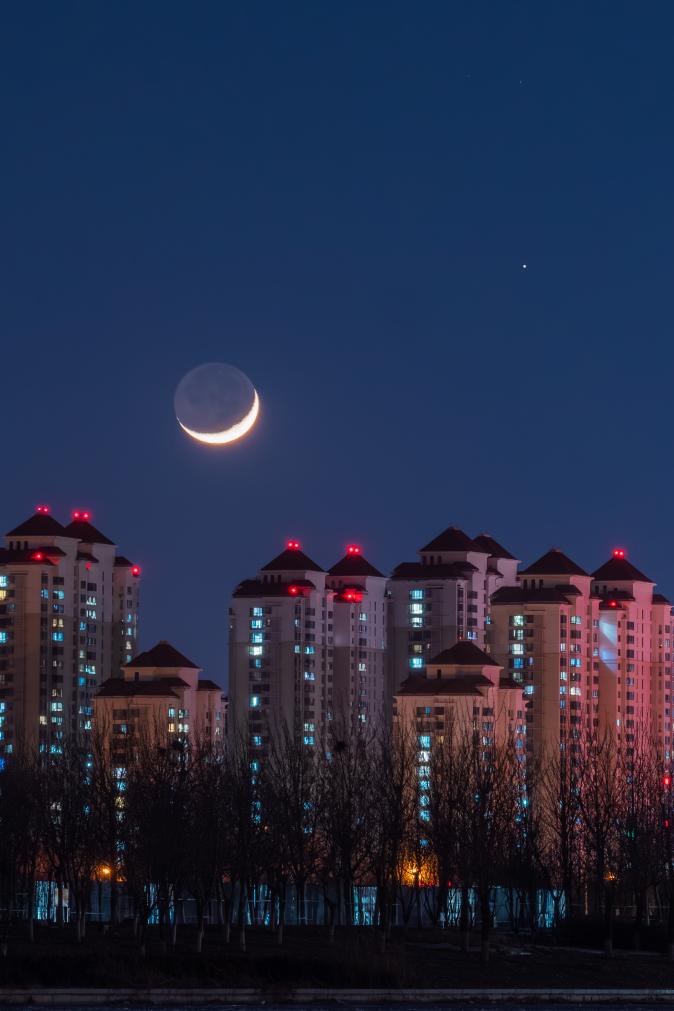
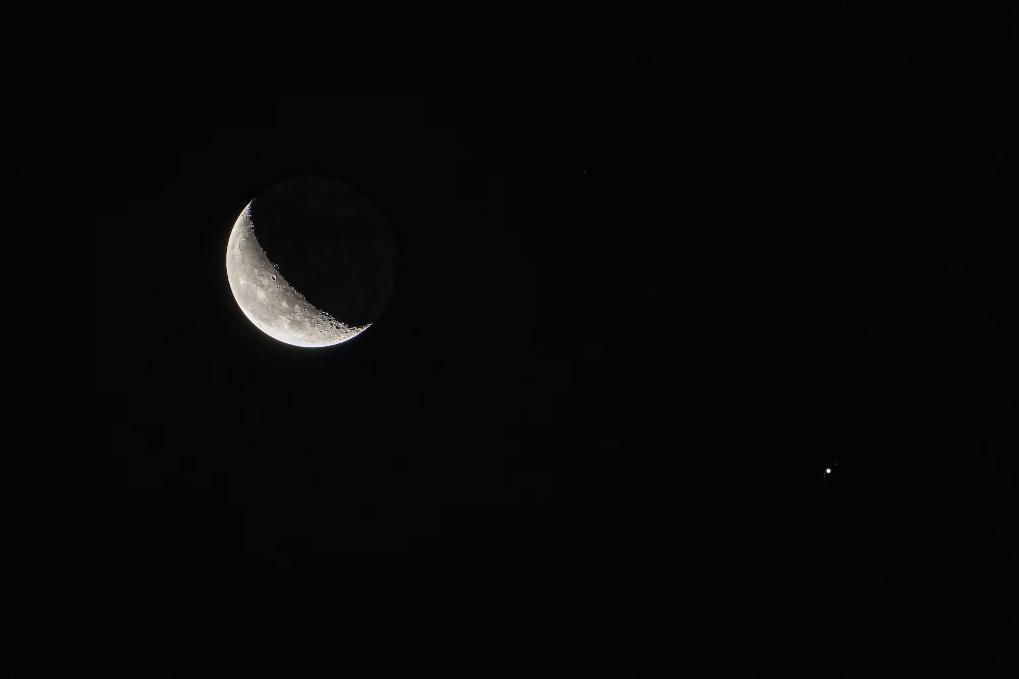
On the 28th, the Moon will appear in the low evening sky. That day coincides with the 2nd day of the fifth lunar month, and a very thin crescent moon can be seen in the low sky, slightly north of west, after sunset. Not far below and to the left of the crescent moon is the bright Jupiter, with a magnitude of -1.9. Although it is far less bright than its peak magnitude of -2.94, it still shines like a gem. Set against the twilight, the two celestial bodies look well-matched and harmonious, highly ornamental, forming a beautiful scenic view in the sky.
"Although this 'star-moon fairy tale' is pleasing to the eye, the observable 'window period' is very short—less than half an hour. This is because Jupiter sets earlier than the crescent moon. The public who are interested should seize the time to watch it," reminded Yang Jing, a member of the Chinese Astronomical Society and a director of the Tianjin Astronomical Society.
 热门排行
热门视频
热门排行
热门视频